
Adopted Biennial Budget
2026-27 & 2027-28
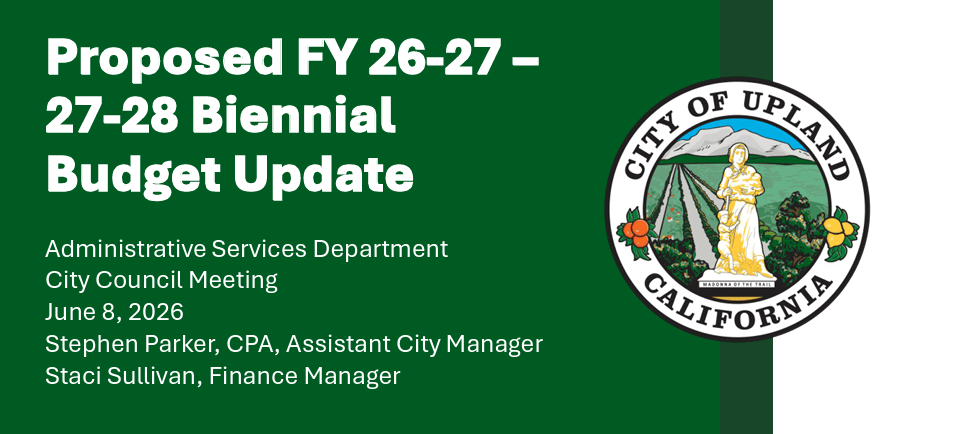
The adopted Fiscal Year 2026-27 through 2027-28 Biennial Budget reflects the difficult financial reality facing the City of Upland while outlining a strategy to maintain essential services and invest in critical infrastructure. The City projects General Fund revenues of approximately $63.6 million in Fiscal Year 2026-27 and $64.9 million in Fiscal Year 2027-28. However, expenditures are expected to exceed revenues by $5.8 million in the first year and $6.2 million in the second year before any corrective actions are taken. These expenditure projections already assume conservative cost-saving measures, including a five percent personnel vacancy allowance, a three percent operational savings allowance, and the pre-funding of building maintenance and information technology internal service funds.
The City's financial challenges are largely the result of declining revenues combined with increasing operating costs. The most significant revenue impact is a projected 12.7 percent decline in sales tax revenue, representing more than $3.2 million less than previously anticipated. At the same time, the City continues to experience rising personnel expenses, increased insurance premiums, higher sales tax sharing obligations, and inflationary pressures affecting nearly every aspect of municipal operations. These cost increases total nearly $4.8 million in Fiscal Year 2026-27 and more than $5 million in Fiscal Year 2027-28, with employee compensation and insurance accounting for the majority of those increases.
Rather than recommending significant reductions to public services, City staff proposes using several one-time financial resources to bridge the short-term budget gap while preserving service levels. First, adjustments to the City's self-funded liability program are expected to generate more than $1 million annually in savings. These changes alone reduce the projected deficit by approximately one million dollars each year.
Staff also recommends utilizing a portion of the City's Section 115 Pension Trust, which currently holds approximately $12 million. By using pension trust savings to offset annual pension obligations, the projected General Fund deficit is reduced by an additional $1.2 million annually.
Because the City's budget shortfall is driven largely by an unexpected decline in sales tax revenues, staff further recommends temporarily using the City's Economic Uncertainty Reserve. This reserve was established specifically to help the City respond to unforeseen economic events, and applying it would reduce the remaining deficit to approximately $282,000 in Fiscal Year 2026-27 and $166,000 in Fiscal Year 2027-28.
The final step in balancing the proposed budget is a recommendation to temporarily redirect park lease revenues into the General Fund for a two-year period. This proposal would generate approximately $423,000 during Fiscal Year 2026-27 and $397,000 during Fiscal Year 2027-28, allowing the City to move from a small remaining deficit to modest projected surpluses of approximately $141,000 and $231,000, respectively. Staff also notes that this temporary redirection would not eliminate funding for future park improvements, as the City is projected to retain approximately $12 million in Quimby and Park Development Impact Fee balances dedicated to parks and recreation projects.
The proposed budget also includes several personnel adjustments designed to improve operational efficiency and address long-standing staffing needs. These include the reclassification of seven existing positions, the addition of one part-time employee, equity adjustments for two positions, the restoration of three Public Works Fleet positions, four new Public Works Operations and Engineering positions, and eight Utility Department positions. Importantly, nearly all of these staffing additions are funded through enterprise funds such as water, sewer, and refuse utilities rather than the General Fund. The four Public Works positions have an estimated General Fund impact of only about $26,000 annually, with the remainder funded through enterprise revenues, while all eight utility positions are fully supported by utility funds.
In addition to addressing the City's financial challenges, the budget continues investing in core municipal services. The Gas Tax Fund includes approximately $1.2 million in additional operating expenditures to improve landscape maintenance services, accelerate the City's tree trimming cycle from every seven years to every four years, and support staffing necessary to maintain public infrastructure. Water and sewer expenditures are aligned with the City's recently adopted five-year master plans, ensuring continued investment in essential infrastructure. However, staff also cautions that the Solid Waste Fund is projected to experience a negative cash balance by June 30, 2027, unless refuse rates are adjusted in the future.
Overall, the proposed biennial budget reflects a fiscally responsible effort to navigate a period of significant economic uncertainty while preserving essential City services. Rather than relying on service reductions, the proposal strategically utilizes one-time savings, reserves, and dedicated funding sources to maintain operations and continue investing in public safety, infrastructure, and quality-of-life improvements. At the same time, the budget makes clear that these are temporary solutions and that long-term fiscal sustainability will ultimately require either additional ongoing revenues, continued expenditure reductions, or a combination of both.
Disclaimer: The Upland Update is an independent community resource and is not affiliated with the City of Upland. This is my personal initiative to keep residents and businesses informed about key issues, city developments, and community events that impact our daily lives. My goal is to ensure you have clear, transparent, and timely information to stay engaged and involved in shaping Upland’s future.
James Breitling
(909) 342-2523
info@theuplandupdate.com
© 2025. All rights reserved.