
Pavement Management Plan Update part 2
With Llnk to watch the staff presentation.
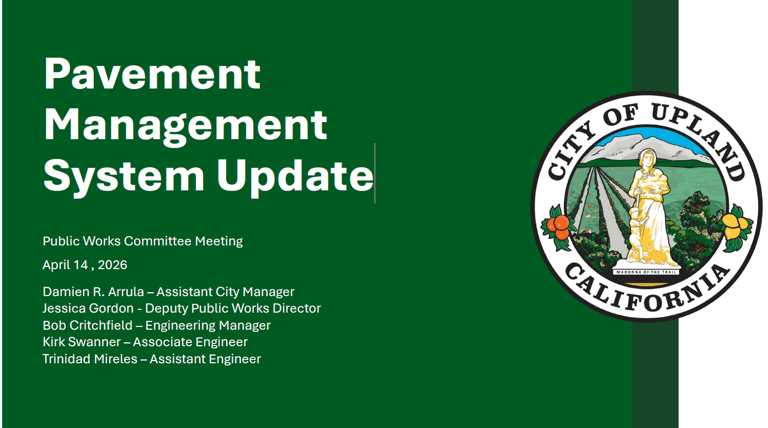
April 27th City Council meeting presentation of the Pavement Management System Update
https://youtu.be/LDXHZi6-_4U?t=3054 Click the link to watch the presentation by public works staff
The Pavement Management System Update presentation provides a comprehensive, data-driven overview of the City of Upland’s roadway network, its current condition, the causes of deterioration, the financial realities the City faces, and the strategic path forward.
The presentation begins with background context, noting that staff presented an initial update to the Public Works Committee on April 30, 2024, completed the full Pavement Management Report in September 2024, and formally presented it to the City Council in October 2024. The purpose of this effort is to move beyond reactive repairs and toward a structured, long-term pavement management strategy. It emphasizes that roads are among the City’s most valuable infrastructure assets, representing hundreds of millions of dollars in replacement cost, and that their condition directly impacts quality of life, safety, emergency response, liability exposure, and property values.
A central theme of the presentation is how pavement deteriorates. Roads do not decline at a steady rate; instead, they follow a curve where they remain in relatively good condition for a period, then rapidly deteriorate once they reach a critical threshold. The presentation identifies a “point of no return,” where delaying maintenance results in exponentially higher costs. Early preservation treatments are far more cost-effective than waiting until reconstruction is required. For example, preservation treatments are shown to cost only a fraction compared to rehabilitation and full reconstruction, with reconstruction costing up to sixteen times more than preservation. The analogy is made that neglecting maintenance like failing to put oil in an engine, leads to total system failure.
The presentation explains that a Pavement Management System is a structured, data-driven tool used to evaluate road conditions, predict deterioration, and prioritize maintenance strategies. It maintains a full inventory of roadway segments, determines current conditions, forecasts future decline using industry models, and recommends the most cost-effective timing for treatments. It also evaluates budget scenarios and identifies funding needs. The system relies on the Pavement Condition Index (PCI), a standardized scale from 0 to 100, where roads are categorized from “failed” to “very good.” Best practice is to reassess conditions every two to three years to ensure accurate planning.
The City’s roadway network is extensive, consisting of approximately 2,500 segments covering 46 million square feet, including 192 centerline miles of roads and 37 miles of alleys, with an estimated total replacement value of $55 million. Roads are classified into arterials, collectors, and local streets, each serving different traffic functions, from high-volume mobility corridors to low-speed neighborhood access. The system also documents various pavement distress types such as transverse cracking, alligator cracking, longitudinal cracking, potholes, raveling, patching, and other failures, all of which are measured and analyzed using modern data collection technologies including laser-based systems that are significantly more efficient and objective than traditional visual inspections.
The current condition of the City’s pavement system is a key concern. Upland’s overall PCI is 53, which is significantly below the regional average of 69 and among the lowest in the region. The City’s stated target is to reach a PCI range of 76–80, which represents a “good” condition network. The gap between current conditions and this target highlights the extent of deterioration and the need for sustained investment.
Financially, the presentation makes clear that the City faces a substantial funding shortfall. Current annual funding levels are approximately $6.8 million, while maintaining the existing PCI requires $16.4 million annually, resulting in an annual shortfall of roughly $9.6 million. To improve conditions to a PCI of 70 would require approximately $28.1 million annually. The City is also carrying an estimated $210 million in deferred maintenance liability, reflecting years of underinvestment. These figures do not include additional needs such as public parking lots.
The presentation also highlights the City’s alley system, where a 48-year plan adopted in 2017 aimed to reconstruct 19.5 miles (53%) of alleys, with the remaining 17.5 miles (47%) to be addressed every 10 years. The program is currently in year six but faces funding shortfalls, relying on sources such as the General Fund and one-time federal ARPA funds, which are not sustainable long-term solutions.
A critical factor contributing to the current situation is staffing. The accumulation of deferred maintenance is directly tied to limited resources and reduced staffing in engineering and operations. The City lacks sufficient CIP (Capital Improvement Program) engineering analysts and administrative support, which has slowed project delivery timelines. At the same time, the Streets Maintenance Division is responsible for a wide range of services beyond pavement repair, including sidewalks, striping, weed abatement, graffiti removal, traffic control, and more. A comparative analysis shows that Upland has significantly fewer staff than comparable cities, approximately 0.10 engineering staff per 1,000 residents versus a regional average of 0.19, meaning Upland is roughly 47% below average.
Cost escalation has further compounded the challenge. Since 2006, reconstruction costs have increased by approximately 197%, and asphalt costs have risen by approximately 148%, while staffing levels have declined by roughly 50% and infrastructure demands have increased. This combination has resulted in declining pavement conditions and rising long-term costs.
Despite these challenges, the presentation outlines several strategies already implemented by staff to improve efficiency and outcomes. These include enhancing project management training, adopting new preservation technologies such as rubberized asphalt and slurry seals, streamlining procurement through cooperative purchasing and piggybacking contracts, combining bid packages, and creating a bench of qualified consultants to accelerate design and construction processes.
Looking ahead, the City is evaluating potential funding sources, including business license tax reform, a possible transaction and use (sales) tax measure, solid waste program fees, federal, state, and county grants, and other external funding opportunities. However, the presentation makes clear that additional staffing is also necessary, estimating the need for approximately 10 additional engineering division staff to adequately address the backlog and deliver projects efficiently.
The next steps outlined include securing additional funding sources, addressing staffing gaps, preparing an updated Pavement Management Report, returning to the Public Works Committee and City Council for further review in 2027, and implementing a strategy to increase the City’s PCI from 53 to the target range of 76–80. The City will also evaluate structural organizational changes, such as creating a dedicated Right-of-Way Division, to improve service delivery.
In summary, the presentation clearly demonstrates that Upland’s pavement challenges are the result of long-term deferred maintenance, rising construction costs, and insufficient funding and staffing. However, it also lays out a clear, data-driven roadmap for improvement. The City Council is determined to get this under control by making informed investments, improving operational efficiency, pursuing new funding opportunities, and implementing a long-term strategy to restore and maintain the City’s roadway system at acceptable standards for residents and businesses.
Disclaimer: The Upland Update is an independent community resource and is not affiliated with the City of Upland. This is my personal initiative to keep residents and businesses informed about key issues, city developments, and community events that impact our daily lives. My goal is to ensure you have clear, transparent, and timely information to stay engaged and involved in shaping Upland’s future.
James Breitling
(909) 342-2523
info@theuplandupdate.com
© 2025. All rights reserved.