
Special City Council Meeting
PROPOSED FISCAL YEAR 2026-27 – 2027-28 BIENNIAL BUDGET
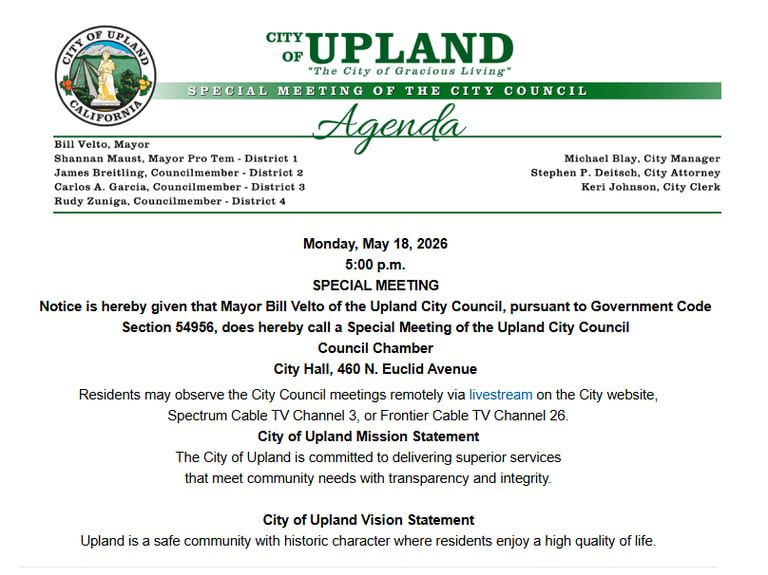
Proposed FY 2026–27 and FY 2027–28 Biennial Budget Summary
The proposed FY 2026–27 and FY 2027–28 Biennial Budget reflects one of the most financially challenging budget cycles the City of Upland has faced in recent years. City staff emphasized throughout the presentation that the City is attempting to preserve core services, maintain infrastructure investments, protect public safety operations, and continue long term capital improvements despite declining sales tax revenues, rising operational costs, increasing pension obligations, and dramatically escalating insurance premiums. The budget continues the City’s broader philosophy of remaining fiscally self reliant while protecting the quality of life residents expect.
The proposed General Fund budget projects approximately $63.6 million in revenue for FY27 against roughly $69.3 million in expenditures, creating an estimated deficit of approximately $5.7 million. For FY28, revenues are projected at approximately $64.9 million against expenditures of approximately $71 million, resulting in an estimated deficit of approximately $6.1 million. Staff is proposing a series of one time reserve uses, funding reallocations, and stabilization strategies to temporarily balance the budget while avoiding major reductions in services.
Major Financial Challenges
One of the largest issues facing the City continues to be declining sales tax revenue. HdL, the City’s sales tax consultant, revised projections downward again following updated fourth quarter sales tax data. The City experienced approximately a $3.2 million reduction in projected sales tax revenues, representing roughly a 12.7% decline from prior expectations. Sales tax remains Upland’s single largest discretionary General Fund revenue source, making this decline especially significant.
Key Revenue Concerns
FY27 sales tax projections reduced by approximately $645,846
FY28 sales tax projections reduced by approximately $746,846
FY27 projected sales tax revenue: approximately $22.63 million
FY28 projected sales tax revenue: approximately $23.25 million
The budget also reflects substantial increases in operational and personnel costs. Personnel costs remain the City’s largest expense category and continue increasing due to negotiated cost of living adjustments, merit increases, overtime pressures, and staffing demands.
Major Cost Increases
Bargaining Unit COLAs: approximately $810,000 in FY27 and $835,000 in FY28
Merit increases and employee roster changes: approximately $914,000 in FY27
Police overtime increases: $500,000 annually
Recreation part time staffing increases
Fleet staffing restoration costs
Significant workers compensation and liability insurance increases
One of the most concerning trends in the budget is the dramatic increase in insurance costs.
Insurance Cost Increases
General Liability Insurance increase:
FY27: approximately $1.4 million
FY28: approximately $2 million
Workers Compensation premiums also increase substantially
These increases mirror broader statewide municipal insurance market challenges impacting cities throughout California.
Pension and Reserve Strategies
To address growing pension obligations, the City is proposing use of its Section 115 Pension Trust. As of April 2025, the Pension Trust balance was approximately $12 million. Staff recommends using over $1.2 million in FY27 and approximately $1.14 million in FY28 to offset increasing unfunded pension liability payments.
Staff stated this strategy is intended to stabilize annual pension payments and create a manageable long term payment structure while allowing the City additional time to identify recurring revenue solutions.
Pension Strategy Highlights
Current Pension Trust balance: approximately $12 million
FY27 proposed Pension Trust usage: approximately $1.2 million
FY28 proposed Pension Trust usage: approximately $1.14 million
Goal is to stabilize annual UAL payments near $10.35 million through FY31
The City also plans to use the Economic Uncertainty Reserve due to the substantial sales tax decline.
Economic Uncertainty Reserve Usage
FY27 proposed use: approximately $3.18 million
FY28 proposed use: approximately $3.29 million
Reserve policy requires replenishment within five years
Additionally, the City changed how self funded liability insurance costs are allocated among departments and funds. This accounting adjustment created temporary General Fund savings that are now being used to help reduce the projected deficit.
Self Funded Liability Savings
FY27 savings used: approximately $1.02 million
FY28 savings used: approximately $1.5 million
Public Works and Infrastructure Investments
Despite the City’s financial challenges, the proposed budget continues major investments in infrastructure, utilities, roads, and public works staffing. The City is continuing aggressive capital improvement spending through Measure I, RMRA, Water Utility funds, and other infrastructure programs.
Major Infrastructure Investments
Measure I capital projects: approximately $14.6 million in FY27
RMRA road projects: approximately $12.8 million in FY27
Water Utility capital projects: approximately $6 million in FY27
General Fund capital projects: approximately $4.2 million in FY27
The budget also proposes several new Public Works and utility related positions to support growing infrastructure demands.
Proposed Public Works Staffing Additions
Three Engineering Technician positions
One Public Works Inspector
One Senior Engineer
One Associate Engineer
Two Utility Worker III positions
Four Utility Worker V positions
Restoration of frozen fleet maintenance positions
These additions reflect increasing operational workloads tied to capital projects, water infrastructure, utilities, and maintenance operations.
Parks and Community Funding ChangesThe Finance Committee also supported temporarily redirecting park lease revenues back into the General Fund for two years. In 2023, the City had designated those revenues specifically for parks within certain districts. Staff now recommends pausing that restriction due to current General Fund pressures and increased costs associated with tree trimming and landscape maintenance.
The report also notes that approximately $12 million in Quimby and Park Development Impact Fee funds are available for future park improvements and projects.
Existing Park Lease Fund Balances
District 1: approximately $136,000
District 2: approximately $129,000
District 4: approximately $473,000
The Finance Committee additionally supported increasing discretionary funding for elected officials.
Proposed Council Discretionary Funding
$25,000 allocated to the Mayor
$25,000 allocated to each Councilmember
Total annual cost: approximately $125,000
Staff stated this proposal is intended to create more equitable opportunities for all elected officials to support community events and initiatives citywide.
Personnel and Organizational Changes
The budget includes several reclassifications and organizational adjustments intended to improve recruitment, retention, operational efficiency, and internal equity.
Proposed Reclassifications
Finance Manager → Deputy Director of Finance
Human Resources Analyst → Principal HR/Risk Analyst
Assistant Planner → Associate Planner
Senior Planner → Principal Planner
Economic Development Coordinator → Principal Economic Development Coordinator
The overall General Fund impact of proposed personnel changes is relatively modest, although total all funds impacts exceed approximately $1.8 million.
Potential Concerns and Errors Identified
While the budget successfully avoids immediate service cuts, several concerns remain.
Key Fiscal Concerns
The City still has a structural deficit exceeding $5 million annually without reserve usage
The budget heavily relies on one time funding solutions
Significant reserve drawdowns will need future replenishment
Sales tax growth remains uncertain
Insurance and pension costs continue escalating faster than revenue growth
Overall, the proposed biennial budget reflects a City government attempting to balance competing priorities during a period of financial strain. The budget preserves public safety, infrastructure investment, and service levels while relying heavily on reserves and one time strategies to bridge ongoing structural deficits. The City continues making substantial investments in roads, utilities, parks, staffing, and capital improvements, but long term sustainability will likely require continued fiscal discipline, stronger economic growth, additional revenue generation, and eventual replenishment of depleted reserves.
Click Image to View Agenda
Disclaimer: The Upland Update is an independent community resource and is not affiliated with the City of Upland. This is my personal initiative to keep residents and businesses informed about key issues, city developments, and community events that impact our daily lives. My goal is to ensure you have clear, transparent, and timely information to stay engaged and involved in shaping Upland’s future.
James Breitling
(909) 342-2523
info@theuplandupdate.com
© 2025. All rights reserved.