Understanding Upland's Water and Sewer Rate Adjustments
Approved Rate Water and Waste Water Increases
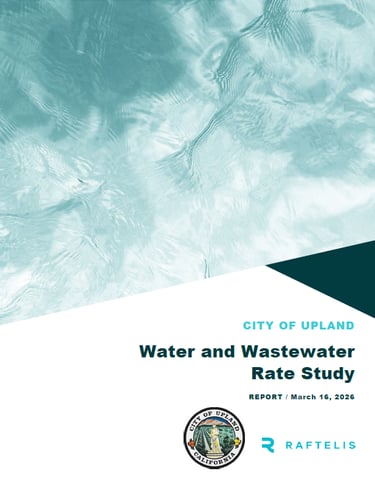
Over the past several months, the Upland City Council reviewed a comprehensive Water and Wastewater Rate Study prepared by an independent utility finance consultant. The purpose of the study was to evaluate the long-term financial health of the City's water and wastewater systems, identify future infrastructure needs, and determine whether existing rates would be sufficient to continue providing reliable service.
After reviewing the study, utility master plans, infrastructure conditions, regulatory requirements, and financial projections, the City Council considered a series of water, recycled water, and sewer rate adjustments designed to maintain safe, reliable, and financially sustainable utility services for years to come.
Why Are Rates Increasing?
The primary reason is simple: the cost of providing water and sewer service has increased significantly while revenues generated by current rates have not kept pace.
The City's utility systems face several major challenges:
Aging water and sewer infrastructure
Rising wholesale water costs
Increased costs for electricity, chemicals, equipment, and maintenance
Inflationary pressures affecting all utility operations
New state and federal water quality regulations
Future treatment requirements for PFAS ("forever chemicals") and other emerging contaminants
The need to maintain emergency reserves and financial stability
Replacement and rehabilitation of aging wells, pumps, reservoirs, pipelines, and treatment facilities
The study concluded that revenues generated by current rates are no longer sufficient to fund ongoing operations, maintain aging infrastructure, meet debt obligations, and prepare for future regulatory requirements.
Why This Matters
Water and wastewater systems are among the most important services a city provides.
Residents expect:
Clean, safe drinking water
Reliable water pressure
Fire protection capability
Sewer systems that function properly every day
Infrastructure that operates safely and efficiently
Maintaining these systems requires continuous investment. Much of Upland's infrastructure has been in service for decades and is reaching the point where major rehabilitation or replacement is necessary. Deferring these investments only increases future costs and risks system failures.
What Happens If Rates Are Not Increased?
The Proposition 218 notice and rate study identified several consequences if rates remain unchanged.
Deferred Infrastructure Projects
Critical water and sewer projects would need to be delayed because sufficient funding would not be available.
Increased Risk of System Failures
Aging pipes, wells, pumps, and treatment facilities would remain in service beyond their intended lifespan, increasing the likelihood of failures and emergency repairs.
Financial Instability
The Water Enterprise Fund would eventually fall below recommended reserve levels and face challenges meeting future financial obligations. The study projected that reserve targets would begin to be missed around FY 2029 and debt service requirements would become difficult to meet beginning around FY 2028 if rates remained unchanged.
Regulatory Risks
Failure to maintain infrastructure and treatment systems could result in increased oversight, compliance issues, and potential fines from regulatory agencies.
Higher Costs Later
History has consistently shown that deferred maintenance almost always becomes more expensive than planned replacement. Emergency repairs typically cost substantially more than proactive infrastructure investments.
What Was Approved?
Water Rates
The study recommended annual water revenue adjustments of approximately 5% per year over five years.
Effective Date
Revenue Adjustment
July 1, 2026
5%
January 1, 2027
5%
January 1, 2028
5%
January 1, 2029
5%
January 1, 2030
5%
Because water rates are based on actual customer usage and meter size, individual customer impacts may vary.
Sewer Rates
The sewer system will also receive phased rate adjustments over five years.
The sewer bill consists of two separate components:
City of Upland Local Sewer Service Charge
Inland Empire Utilities Agency (IEUA) Regional Treatment Charge
The City only controls the local sewer portion. Treatment costs are established by IEUA and passed through to customers.
How Were The Rates Determined?
The City hired Raftelis Financial Consultants, a nationally recognized utility finance firm, to conduct an independent analysis of the City's utility operations and finances.
The study evaluated:
Operations and maintenance costs
Capital improvement needs
Debt obligations
Water demand projections
Sewer demand projections
Infrastructure replacement schedules
Reserve requirements
Regulatory compliance costs
The goal was to establish rates that are legally compliant with Proposition 218 and sufficient to recover the actual cost of providing service.
How Do Upland's Rates Compare To Neighboring Agencies?
One of the most common questions I received from residents was whether Upland's rates would remain competitive after the increases.
The answer is yes.
Water Rate Comparison
Typical Single-Family Home (5/8" Meter, 36 HCF Bi-Monthly Usage)
Agency Water Bill
CVWD
$153
Upland Current
$161
Upland Proposed
$167
Pomona
$168
Chino
$169
Ontario
$185
MWWD
$204
La Verne
$253
Claremont (GSWC)
$260
What This Means
Upland remains among the lowest-cost providers in the region.
The average increase for a typical household is approximately $6 every two months.
Even after the adjustment, Upland remains less expensive than Ontario, La Verne, Claremont, and several other regional providers.
Sewer Rate Comparison
Typical Residential Monthly Sewer Bill
Agency
Sewer Bill
La Verne
$29
CVWD
$34
Upland Current
$37
Pomona
$37
Upland Proposed
$38
Fontana
$39
Chino Hills
$41
Ontario
$42
Chino
$42
Rialto
$71
What This Means
Upland's sewer rates remain highly competitive.
The increase is approximately $1 per month for the local sewer component.
Upland remains below many neighboring agencies and significantly below Rialto.
Average Customer Impact
For a typical single-family residence:
Service Current Proposed Difference
Water (Bi-Monthly)
$161
$167
+$6
Sewer (Monthly)
$37
$38
+$1
For most households, the immediate impact is modest when compared to the long-term infrastructure investments being funded.
Addressing Resident Concerns
During the Proposition 218 process, residents submitted written objections regarding cost-of-service calculations, future rate increases, fixed charges, and pass-through costs.
The City reviewed each objection and provided written responses. The City concluded that:
Rates are supported by an independent cost-of-service study.
Utility rates cannot legally exceed the cost of providing service.
Fixed charges recover costs that exist regardless of how much water is used, including infrastructure, customer service, billing, and system maintenance.
Wholesale pass-through charges are limited to recovering actual costs imposed by outside agencies and cannot be used to generate profit.
Final Thoughts
No one enjoys seeing utility bills increase. However, as your Councilmember, I also recognize the importance of maintaining the infrastructure that delivers clean drinking water to our homes and safely removes wastewater from our community.
The alternative to making these investments today is often far more expensive tomorrow. Deferred maintenance can lead to water main breaks, service disruptions, emergency repairs, regulatory penalties, and significantly higher costs for future generations.
While these adjustments are never easy, the rate study demonstrates that the increases are tied directly to the cost of providing service, funding critical infrastructure improvements, meeting regulatory requirements, and maintaining reliable utility systems. Even after the adjustments, Upland's water and sewer rates remain among the most affordable in the region.
The goal is not to generate profit. The goal is to ensure that Upland's water and wastewater systems remain safe, reliable, financially stable, and capable of serving our community for decades to come.
Click Image Above
Disclaimer: The Upland Update is an independent community resource and is not affiliated with the City of Upland. This is my personal initiative to keep residents and businesses informed about key issues, city developments, and community events that impact our daily lives. My goal is to ensure you have clear, transparent, and timely information to stay engaged and involved in shaping Upland’s future.
James Breitling
(909) 342-2523
info@theuplandupdate.com
© 2025. All rights reserved.