
Water and Wastewater Rate Study Cost of Service Review
City Council approves starting PROP 218 Notice
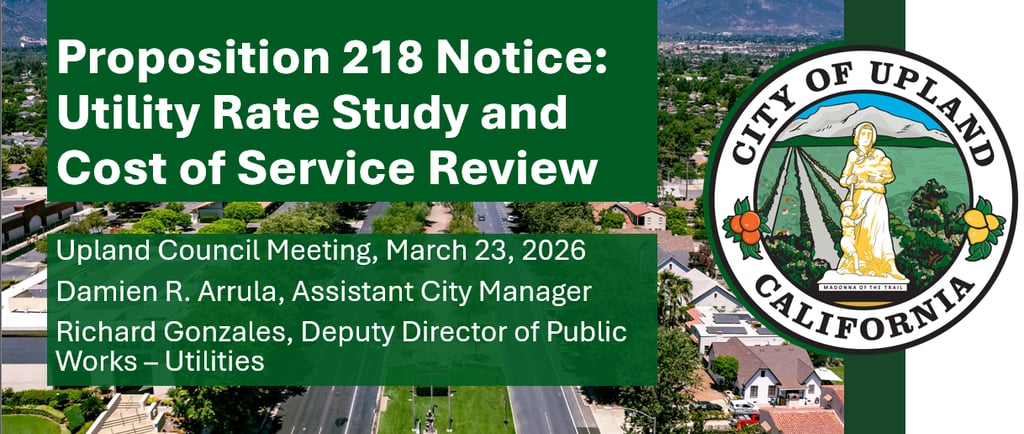
💧 Moving Forward with Upland’s Utility Rate Study
This week, the City Council took an important step toward protecting Upland’s long-term water and wastewater infrastructure by initiating the Proposition 218 process for a comprehensive utility rate study.
It is important to be clear: no rate increases were approved at this meeting. The Council’s action simply begins the public process, including mailing notices to residents and setting a public hearing for June 8, 2026, where the community will have the opportunity to provide input and formally protest if they choose.
🏗️ Why This Matters
Upland operates a large and complex utility system that serves our entire community, including:
Over 439 miles of water lines
More than 210 miles of sewer lines
13 reservoirs and 11 active wells
A treatment system capable of handling 6 million gallons per day
Maintaining this system is not optional—it is essential to public health, fire protection, and the reliability residents expect every day.
This rate study is the first in over a decade to fully integrate updated infrastructure master plans, ensuring that future investments are based on real system needs, not estimates.
⚠️ The Reality We Face
Like many cities across California, Upland is dealing with:
Aging infrastructure that requires reinvestment
Increasing costs for water supply, maintenance, and regulatory compliance
Rising regional treatment costs from the Inland Empire Utilities Agency (IEUA)
The need to address emerging contaminants like PFAS
If no action is taken, City projections show:
Water system reserves could fall below safe levels by 2029
Wastewater reserves could be depleted by 2034
That leads to deferred maintenance, emergency repairs, and significantly higher costs down the road.
📈 A Responsible, Phased Approach
The proposed plan focuses on stability and fairness:
Year 1: Adjusts rates to reflect the true cost of service and corrects imbalances between customer groups
Years 2–5: Modest, predictable annual increases (approximately 4–5%) to avoid sudden spikes
This approach ensures the City can maintain infrastructure responsibly while minimizing impacts to ratepayers.
🚰 Understanding External Costs
A portion of your sewer bill is controlled by the Inland Empire Utilities Agency (IEUA), which sets regional treatment rates. These costs are passed through directly to customers without markup and have recently increased by 9% annually.
The City does not control these charges but must account for them to maintain system operations.
🗳️ What Happens Next
Residents will receive a Proposition 218 notice in the mail outlining the proposed changes. The process includes:
A 45-day public review period
A public hearing on June 8, 2026
The opportunity to submit formal written protests
The City Council can only adopt the proposed rates if a majority protest is not received.
📌 Final Thoughts
This is about long-term responsibility.
For years, some rate adjustments were deferred to provide short-term relief. While understandable, those delays have created growing financial pressure on critical infrastructure.
This proposal represents a balanced path forward—one that prioritizes:
Reliable water and sewer service
Responsible infrastructure investment
Predictable and transparent rate planning
Most importantly, this process ensures that residents have a voice every step of the way.
As always, I encourage you to stay informed, review the materials when they arrive, and participate in the upcoming public hearing.
Click Image Above to View Presentation
Disclaimer: The Upland Update is an independent community resource and is not affiliated with the City of Upland. This is my personal initiative to keep residents and businesses informed about key issues, city developments, and community events that impact our daily lives. My goal is to ensure you have clear, transparent, and timely information to stay engaged and involved in shaping Upland’s future.
James Breitling
(909) 342-2523
info@theuplandupdate.com
© 2025. All rights reserved.